
Could your high-pressure washer be the biggest threat to your home’s curb appeal? Most Perth property owners view a pressure cleaner as the ultimate solution for grime, but when it comes to cleaning outdoor limestone pavers perth residents often find that aggressive blasting leads to permanent pitting and accelerated erosion. To understand how professional standards differ from DIY efforts, you can learn more about safe power washing practices. It’s a frustrating cycle where the stone looks better for a week, only to trap more red dust and black algae in its newly opened pores.
We understand that maintaining natural stone in Western Australia’s harsh environment is a constant battle against salt attack and bore water staining. You want a pristine alfresco area without compromising the structural integrity of the stone. This guide shares the professional restoration methods used to achieve a durable, non-slip finish that stands up to our extreme UV levels and coastal winds. We’ll explore why the industry is moving toward diamond honing and breathable penetrating sealers to ensure your investment remains a protected asset for years to come.
Key Takeaways
- Understand the geological vulnerability of Perth limestone and why its high porosity requires a specialized approach to avoid permanent erosion.
- Learn the professional sequence for cleaning outdoor limestone pavers perth using pH-neutral agents that break down organic growth without etching the stone surface.
- Differentiate between high-pressure blasting and mechanical diamond honing to determine the best restoration method for removing deep stains and surface pitting.
- Discover how high-grade penetrating sealers act as a critical form of asset protection against salt attack, red dust, and Perth’s common bore water staining.
- Establish a sustainable “soft wash” maintenance schedule to preserve the slip-resistance and aesthetic appeal of your alfresco and pool areas.
Understanding Perth Limestone: Why Your Outdoor Pavers Are Deteriorating
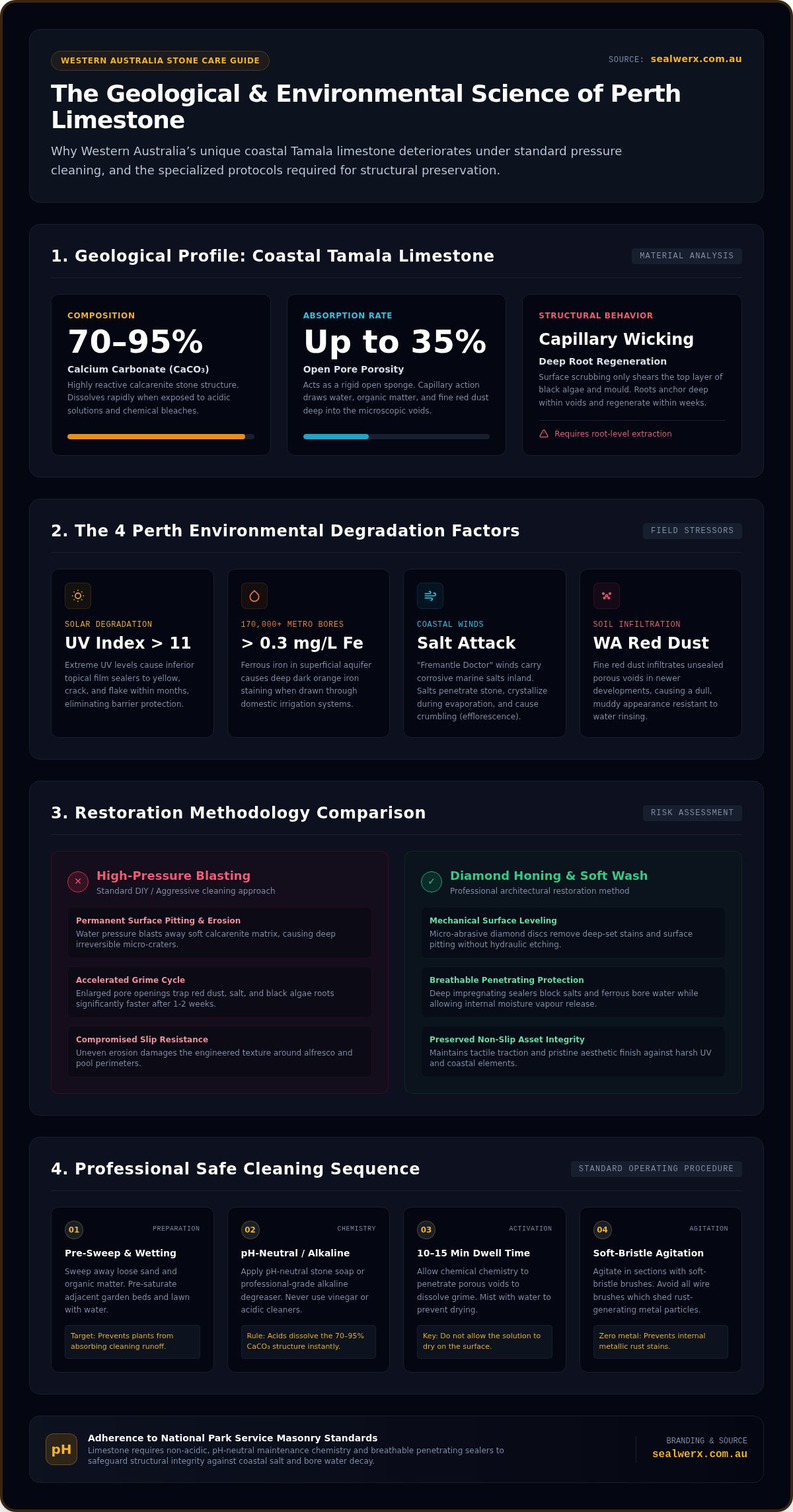
Perth’s outdoor lifestyle relies heavily on the aesthetic appeal of natural stone. However, the very characteristics that make limestone attractive also make it vulnerable. Most local installations use coastal Tamala Limestone, a calcarenite stone known for its high calcium carbonate content, typically ranging from 70% to 95%. Unlike dense clay bricks or man-made concrete, this stone features an open pore structure with porosity levels often reaching 35%. This means the stone acts like a rigid sponge, absorbing everything from winter rain to summer spillages.
Maintaining these surfaces requires a departure from standard masonry care. Limestone is chemically sensitive; it’s a “soft” stone that reacts poorly to acidic cleaners and high-pressure water. While a concrete driveway might handle aggressive scrubbing, limestone will etch, pit, or crumble under the same treatment. Professional cleaning outdoor limestone pavers perth specialists focus on preserving the stone’s structural integrity while addressing the specific environmental stressors found in Western Australia.
The Role of Porosity in Surface Staining
Stains on limestone aren’t just surface-deep. The stone’s capillary action “wicks” liquid contaminants deep into its core, where they become trapped. This is why a simple hose-down rarely works. When organic matter like black algae or mould takes root, it anchors itself within these microscopic voids. Surface-level scrubbing only removes the top layer of growth, leaving the roots to regenerate within weeks. The lower the density of your specific pavers, the more frequently you’ll notice this deep-set discolouration, making professional extraction essential.
Perth Environmental Factors: Salt, Dust, and Sun
Perth’s climate presents a unique set of challenges for stone preservation. Our extreme UV levels, which routinely exceed a UV Index of 11, cause inferior topical sealers to yellow, crack, and flake within months. Once the protective layer fails, the stone is exposed to the “Fremantle Doctor” winds that carry corrosive coastal salts kilometres inland. These salts penetrate the stone and expand during evaporation, leading to surface crumbling.
Bore water irrigation adds another layer of complexity. With over 170,000 domestic bores in the Perth metro area, many properties suffer from dark orange iron staining caused by ferrous iron concentrations exceeding 0.3 mg/L in the superficial aquifer. Efflorescence is the migration of salts to the stone surface. In newer developments, fine red dust infiltrates these open pores, creating a dull, muddy appearance that resists standard cleaning outdoor limestone pavers perth methods. Proper asset protection starts with acknowledging that limestone requires specialized, pH-neutral care to survive the local environment.
A Step-by-Step Guide to Safely Cleaning Limestone Pavers
Safely cleaning outdoor limestone pavers perth requires a methodical approach to avoid damaging the stone’s delicate surface. Start by sweeping away loose sand, leaves, and organic debris. Wet down any adjacent garden beds or lawn areas before you begin. This saturation prevents the plants from absorbing any runoff during the cleaning process. It’s a simple step that protects your landscaping investment while you focus on the stone restoration—a balance often highlighted by outdoor care teams like Snappy Landscaping when coordinating hardscape projects with lawn and plant health.
Choosing the Right Cleaning Solution
Avoid using common household pantry items like vinegar or harsh industrial bleach. These substances are either too acidic or too alkaline for natural stone. Acidic cleaners dissolve the calcium carbonate in limestone, leading to immediate etching and surface loss. Instead, select a professional-grade alkaline degreaser or a pH-neutral stone soap. This aligns with National Park Service guidance on masonry cleaning and water repellents, which warns that harsh chemicals can cause irreversible surface damage. A safe cleaner will break down organic grime without compromising the stone’s structural integrity.
Apply your chosen solution and let it sit for 10 to 15 minutes. This is known as “dwell time.” It allows the chemistry to penetrate the pores and lift deep-set dirt. Don’t let the solution dry on the surface; mist it with water if needed. Once the grime is loosened, use a soft-bristle brush to agitate the area. Avoid wire brushes as they can leave metal fragments that rust within the stone. Work in small sections to ensure consistent results across your entire alfresco or pool area.
Pressure Washing: The Professional Technique
High-pressure water can be a tool or a weapon. If you use a standard turbo head or a narrow nozzle, you risk creating “tiger stripes” or permanent pitting. These are deep gouges where the water has blasted away the soft stone matrix. Keep your pressure unit below 1,200 PSI and always use a wide-fan nozzle. This controlled approach removes residue without eroding the surface. If you’re concerned about the condition of your stone, a professional stone cleaning and sealing service can restore the finish safely using industrial-grade equipment.
Rinsing and neutralisation are the final critical steps. Ensure every trace of the cleaning agent is flushed away. Any leftover residue can attract more dirt or interfere with the bonding of a future sealer. By following this systematic process, you’ll achieve a deep clean that respects the stone’s natural properties and prepares it for long-term protection.
Professional Honing vs. High-Pressure Cleaning: Which Is Right?
Standard high-pressure washing is often the first choice for removing surface grime, but it doesn’t address the physical damage within the stone. For many homeowners, cleaning outdoor limestone pavers perth becomes a losing battle when the surface is already pitted or etched. This is where professional honing steps in. Honing isn’t just a deeper clean; it’s a restorative resurfacing process that physically repairs the stone by removing a microscopic layer of the damaged substrate.
The Honing Process Explained
Mechanical honing uses a sequence of rotary diamond-impregnated pads to shave away surface imperfections. This process is the only effective way to remove stubborn bore water stains that have chemically bonded with the limestone. While a pressure washer can blast away dirt, it can also exacerbate surface roughness, creating more “pockets” for future grime. Honing smooths these areas out, creating a refined matte finish. Adhering to the Natural Stone Institute stone care guidelines ensures these methods maintain the stone’s structural integrity without relying on aggressive, damaging chemicals.
The visual difference is striking. A pressure-cleaned paver looks bright but often remains porous and rough. A honed paver looks uniform, feels smooth underfoot, and regains its original colour depth. This mechanical closure of the stone’s surface makes it significantly harder for organic growth like black mould to anchor itself, resulting in a surface that stays clean for much longer than one that has only been washed.
Removing Etch Marks and Dull Spots
Limestone is a calcareous stone, meaning it reacts instantly to anything acidic. A spilled glass of wine, citrus juice, or the accidental use of “brick acid” by a general contractor will leave dull, rough etch marks. These aren’t stains; they’re physical burns where the stone has dissolved. No amount of scrubbing will fix this. Mechanical restoration is required to shave the surface down to a fresh, undamaged layer.
At Sealwerx, we specialize in restoring the uniform look of weathered or chemically damaged limestone. If your alfresco area has lost its lustre or feels “chalky” to the touch, a standard wash won’t suffice. You likely require a more comprehensive Stone Restoration Perth service to bring the surface back to its original condition. This approach is particularly vital for pool surrounds. A honed finish provides the necessary slip resistance required for safety while ensuring the stone is easier to maintain and more resistant to the salt and chlorine common in Perth backyards.
Sealing Your Limestone Pavers: The Key to Long-Term Asset Protection
Cleaning outdoor limestone pavers perth is a vital first step, but it’s only a temporary solution if the stone remains unprotected. Because limestone is naturally porous, an unsealed surface acts like a rigid sponge. It will readily absorb oils from your BBQ, tannins from fallen leaves, and red wine from your last alfresco dinner. Without a barrier, these contaminants penetrate deep into the stone’s core, making future cleaning cycles more difficult and less effective. Professional sealing shifts your maintenance approach from reactive scrubbing to proactive asset protection.
The science of modern stone care relies on penetrating sealers, also known as impregnators. Unlike old-fashioned coatings, these products don’t sit on top of the stone. Instead, they travel into the microscopic voids of the limestone and bond with the internal structure. This creates a hydrophobic and oleophobic barrier that repels water and oils while keeping the surface looking completely natural. By investing in high-grade sealing, you significantly reduce the frequency of professional cleaning and ensure your stone retains its “as-new” appearance for years.
Penetrating vs. Topical Sealers for Perth Homes
Perth’s extreme UV exposure, which frequently reaches levels of 11 or higher, is the primary enemy of topical sealers. Glossy acrylic coatings often peel, flake, or turn a milky yellow when exposed to our intense summer sun. More importantly, these film-forming sealers trap moisture within the stone. Because Perth’s sandy soils hold ground moisture that evaporates upward, a non-breathable sealer can cause the stone to suffocate and degrade from the inside out. Penetrating sealers are vapor-permeable, allowing the stone to “breathe” while still blocking liquid ingress. For a deeper look at these technologies, see our guide on Surface Sealing Perth.
Managing Efflorescence and Salt Attack
In coastal suburbs from Cottesloe to Quinns Rocks, salt attack is a major concern. Airborne salts from the Indian Ocean settle on pavers and are carried into the pores by rainwater. As the water evaporates, the salt crystallises and expands, causing the limestone to crumble or “spall.” Sealing stops this wicking action, preventing “salt damp” and the unsightly white powdery residue known as efflorescence. If you’re already seeing these white blooms, you may require a specialized Efflorescence Treatment before the sealing process can begin.
Framing your stone care as a strategic investment helps preserve your property’s market value. A well-maintained, sealed limestone area is a significant selling point in the Perth market. To ensure your outdoor areas are fully protected against the elements, book a professional sealing consultation with Sealwerx today.
Maintaining Your Restored Limestone: Professional Solutions from Sealwerx
Achieving a pristine finish is only half the battle. To ensure your investment remains a protected asset, you must establish a consistent maintenance routine. While professional cleaning outdoor limestone pavers perth residents rely on provides a deep reset, your daily habits determine how long those results last. Effective maintenance prevents organic buildup and keeps the stone’s surface smooth and slip-resistant throughout the seasons. It’s about preserving the restorative work already performed and extending the life of your sealer.
Daily and Weekly Maintenance Tips
Start with the basics. Dry sweeping your pavers at least once a week is the most effective way to prevent grit abrasion. In Perth, fine silica sand and garden debris act like sandpaper underfoot, slowly wearing down the stone’s finish. Use a soft-bristle broom to clear these particles before they can cause microscopic scratches. If you notice a spill, act quickly. Dab the liquid with a clean cloth rather than rubbing it. Rubbing can force the contaminant deeper into the stone’s pores, even on a sealed surface.
For routine washing, use a clean microfibre mop and a dedicated pH-neutral stone soap. Avoid generic floor cleaners that might leave a dulling residue or strip away the protective penetrating sealer. This “soft wash” approach ensures you’re removing surface grime without introducing harsh chemicals that could damage the stone’s calcium-based structure. Consistent, gentle care is the secret to a long-lasting, as-new appearance.
When to Call the Professionals
Even with meticulous care, every sealer eventually reaches the end of its functional life. You can test your protection by performing a simple water bead test. Pour a small amount of water on a high-traffic area. If the water soaks in and darkens the stone within a few minutes, your sealer has failed. This means the stone is once again vulnerable to salt attack, bore water staining, and deep-set organic growth. Attempting DIY stain removal on high-value limestone is a significant risk. Using the wrong chemical agent can cause permanent etching that requires mechanical honing to repair.
Based in Osborne Park, Sealwerx has served the Perth metropolitan area since 2005. We understand the specific challenges posed by the local climate, from the red dust of new developments to the salt spray of coastal suburbs. Our team provides specialized maintenance plans that go beyond simple washing. We focus on long-term durability and craftsmanship, ensuring your outdoor areas remain safe and beautiful. We invite you to contact Sealwerx for a professional limestone assessment to develop a tailored restoration plan for your outdoor living space. Investing in professional expertise today ensures your limestone remains a durable and beautiful feature of your home for decades.
Protect Your Outdoor Investment for the Long Term
Restoring the natural beauty of your alfresco area requires more than just a quick wash. You’ve learned that limestone’s high porosity demands a specialized approach, moving away from aggressive blasting toward restorative honing and pH-balanced care. By choosing high-grade penetrating sealers, you effectively shield your stone from salt attack and the harsh WA sun. This proactive strategy transforms routine maintenance into long-term asset protection. It’s the difference between a temporary fix and a permanent solution for your home.
Professional cleaning outdoor limestone pavers perth results are only sustainable when every pore is treated with the correct chemistry to prevent future deterioration. Since 2005, our team has provided comprehensive stone restoration from our base in Osborne Park. We combine technical honing expertise with premium sealing solutions to deliver a finish that stands up to Perth’s unique environmental stressors. We take pride in our craftsmanship and the durability of every surface we treat.
Request a Specialized Limestone Restoration Quote from Sealwerx to secure your property’s value and aesthetic appeal. Your outdoor living space is a significant investment; let’s ensure it remains a highlight of your home for years to come.
Frequently Asked Questions
Can I use a high-pressure washer on my limestone pavers?
You should avoid using high-pressure washers at maximum settings on soft natural stone. High PSI can cause permanent pitting and erosion, creating unsightly gouges that ruin the aesthetic. For cleaning outdoor limestone pavers perth residents should instead use a wide-fan nozzle at low pressure or seek professional mechanical honing. This ensures the structural integrity of the stone remains intact while removing surface contaminants safely without eroding the delicate surface matrix.
How often should I have my outdoor limestone professionally cleaned and sealed in Perth?
Most Perth properties require professional maintenance every 3 to 5 years. However, coastal homes near the Indian Ocean or those in new developments with high red dust levels may benefit from a 2-year cycle. Regular sealing acts as a form of asset protection, preventing salt attack and organic growth from anchoring deep within the stone’s open pores. We recommend a professional assessment to determine the specific needs of your unique outdoor space.
Will sealing my limestone make the pavers slippery around the pool?
Using a high-grade penetrating sealer won’t increase slipperiness. Unlike topical acrylic coatings that sit on top of the stone, penetrating sealers bond inside the pores, leaving the natural texture unchanged. This is crucial for pool surrounds and alfresco areas where safety is a priority. For extra protection, we offer specialized anti-slip treatments that meet Australian standards for pedestrian surfaces, ensuring your wet areas remain safe and functional for the whole family.
How do I remove black mould from my limestone alfresco?
Black mould thrives in limestone’s porous structure, so a surface-level wash isn’t enough. You need a pH-neutral biocide or a specialized alkaline cleaner that can penetrate the stone and kill the roots. Avoid using harsh household bleach, as it can lead to surface degradation over time. Professional cleaning outdoor limestone pavers perth services use controlled dwell times and agitation to extract organic growth without damaging the delicate calcium-based structure of the natural stone.
What is the best way to remove bore water stains from limestone?
Bore water stains are a chemical bond of iron oxide that standard pressure washing cannot remove. The most effective professional solution is mechanical diamond honing or the application of specialized chelating agents. These methods lift the deep orange discolouration caused by Perth’s iron-rich groundwater. Once the stains are removed, applying a high-grade penetrating sealer is essential to prevent the iron from re-bonding with the limestone during future irrigation cycles.
Can etched or dull limestone pavers be restored to their original look?
Yes, mechanical honing can restore etched or dull pavers to an “as-new” finish. If your stone has been damaged by acidic spills or previous aggressive cleaning, we use rotary diamond-impregnated pads to shave away the damaged surface layer. This process removes etch marks and dull spots, revealing the fresh stone underneath. It’s a precise restoration method that returns a uniform, matte appearance to weathered limestone without the need for costly surface replacement.
Is it possible to clean and seal limestone on the same day?
It’s almost never possible to clean and seal on the same day. Because limestone is exceptionally porous, it holds moisture deep within its core. Applying a penetrating sealer to damp stone prevents the chemical from bonding correctly and can trap moisture inside, leading to white hazing or “blushing.” In Perth’s climate, we typically allow at least 24 hours of drying time after a deep clean before starting the professional sealing process to ensure longevity.
Why are my limestone pavers turning white after cleaning?
White powdery residue is typically efflorescence, which occurs when soluble salts migrate to the stone surface during water evaporation. If the whiteness appears as a hazy film, it might be moisture trapped under an old, non-breathable topical sealer. We specialize in efflorescence treatment and the removal of failed coatings. Identifying the root cause is vital before applying any new protection to ensure the stone remains clear, breathable, and structurally sound for years to come.