
Most homeowners treat stone maintenance as a simple cleaning chore; however, professional marble sealing in Perth is actually a strategic asset protection plan for your property’s most delicate surfaces. You likely invested in natural stone for its timeless elegance, so it’s frustrating to watch that original luster fade under the weight of daily traffic or a single accidental acidic spill. Whether you are dealing with permanent etching from a morning coffee or the confusion of choosing between hardware store sealers and professional-grade solutions, the struggle to keep marble pristine is a common challenge for WA property owners.
We understand that your stone surfaces are more than just benchtops or flooring; they are significant financial investments that require specialized care to withstand our unique local conditions. This guide will show you how to safeguard your marble using high-grade penetrating sealers and mechanical restoration techniques that outperform generic DIY products. You will discover the essential steps to prevent moisture damage, restore a dull finish, and establish a realistic maintenance cycle tailored specifically for the Western Australian climate. This expert overview provides a clear roadmap for keeping your natural stone as resilient as it is beautiful.
Key Takeaways
- Learn how to perform the “Water Drop Test” to accurately check if your stone remains protected or requires immediate professional attention.
- Discover why professional marble sealing in Perth acts as a sacrificial barrier, protecting high-value surfaces from permanent acidic damage.
- Understand why breathable penetrating sealers are superior to topical coatings for maintaining the natural appearance and health of your stone.
- Identify the specific household cleaners that destroy protective seals and learn the maintenance routines that preserve your stone’s finish.
- See why mechanical cleaning and restoration are essential prerequisites to prevent a cloudy or failed finish when applying a new sealer.
Why Marble Sealing is Essential for Perth Properties
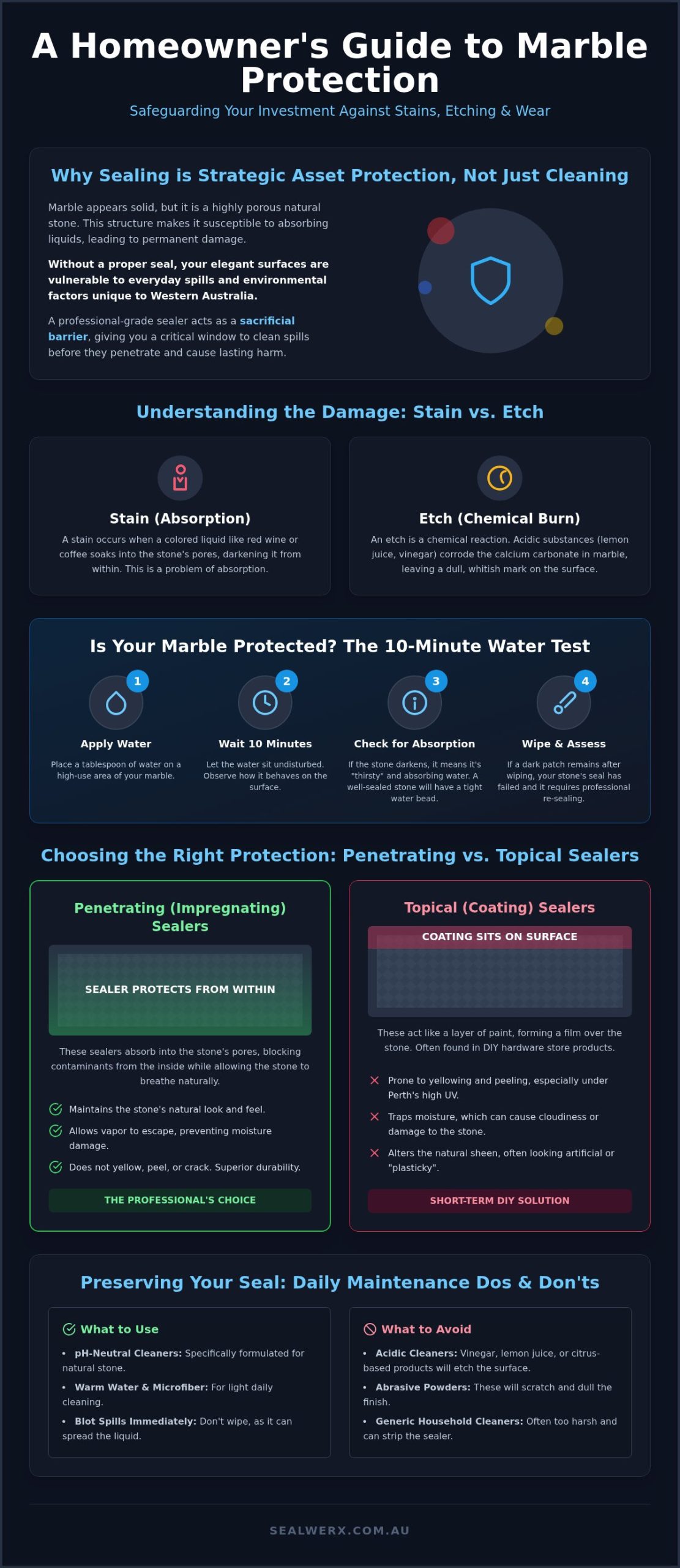
Natural stone is a significant investment that defines the aesthetic of many premium Perth homes. While marble appears solid and impenetrable, it is actually a highly porous material composed primarily of calcium carbonate. This chemical makeup makes it exceptionally sensitive to acidic substances and environmental pollutants. Without professional marble sealing perth, your stone surfaces remain vulnerable to permanent damage that can’t be fixed with a simple wipe down. We view sealing as a strategic form of asset protection rather than a mere cleaning task.
The core of our approach involves creating a “sacrificial barrier” for your stone. A high-quality sealer is designed to sit within the pores or on the surface to absorb the impact of spills, oils, and minerals. Instead of these contaminants reaching the delicate stone fibers, they interact with the sealer first. This gives you a critical window of time to clean up messes before they become permanent fixtures of your benchtop or floor. In the harsh Western Australian climate, this barrier is your first line of defense against the accelerated wear caused by our unique local conditions.
The Chemistry of Marble and Staining
Understanding the difference between a stain and an etch is vital for any property owner. A stain occurs when organic liquids like red wine or coffee are absorbed into the stone’s pores, darkening the material from the inside. An etch, however, is a chemical burn. When acidic substances like lemon juice or coastal salt spray hit unsealed marble, they react with the calcium carbonate and eat away at the surface. This creates a dull, white mark that no amount of scrubbing can remove. In Perth’s coastal suburbs, the airborne salt alone can trigger these reactions over time if the stone isn’t properly shielded.
Perth’s Environmental Impact on Stone
Western Australia presents specific challenges that many generic sealing products simply can’t handle. Our state has one of the highest UV indexes in the world; this intense solar radiation quickly breaks down the chemical bonds in low-quality topical coatings, causing them to yellow, peel, or crack within months. This exposure leaves the stone underneath completely unprotected.
Local water chemistry also plays a major role. In suburbs like Nedlands or Duncraig, where bore water reticulation is common, the high mineral content can cause severe “iron staining” or white calcification on outdoor marble features. Additionally, the high-alkalinity dust blown in from the foothills can settle into unsealed pores, leading to a gritty, dull appearance that is difficult to reverse. Professional-grade penetrating sealers are essential here because they allow the stone to breathe while repelling these specific mineral-heavy threats, ensuring your investment retains its resale value for the long term.
How to Tell if Your Marble Needs Resealing: The 10-Minute Test
Many homeowners rely on a visual check to decide if their stone needs attention. If it looks shiny, they assume it’s protected. This is a mistake. Dullness often indicates etching, which is a chemical burn, rather than a failed seal. Conversely, a stone can look perfectly polished while its internal pores are wide open to oil and water absorption. Effective marble sealing perth requires a more scientific diagnostic approach than a simple glance.
The frequency of resealing depends heavily on usage and the type of sealer previously applied. A high-traffic kitchen island used for daily meal prep might require attention every 1 to 3 years. In contrast, a guest bathroom vanity that sees little use could remain protected for 5 years or more. Understanding your stone’s “thirst” level is the only way to prevent permanent staining before it occurs. If you can’t remember the last time your stone was treated, it’s likely time for a check.
Performing the Water Drop Test at Home
This industry-standard test is the most reliable way to check your stone’s porosity without specialized equipment. It’s a simple diagnostic you can perform in minutes:
- Step 1: Place a tablespoon of water on several sections of the marble, focusing on high-use areas like near the sink or stove.
- Step 2: Monitor the water for 10 minutes. If the stone is well-sealed, the water will bead tightly on the surface.
- Step 3: Observe if the stone begins to darken. A “thirsty” stone will pull the water into its pores, creating a dark patch.
- Step 4: Wipe the water away. If a dark shadow or ring remains for more than a minute, your sealer has failed and the stone is vulnerable.
Other Warning Signs of Sealer Failure
Beyond the water test, your stone often communicates its needs through subtle physical changes. If you notice your grout lines are becoming darker or harder to clean, it’s often because the sealer has worn away, allowing dirt to anchor deep into the cement. You might also find the stone feels “sticky” or seems to attract dust faster than usual. This occurs when the protective barrier degrades and allows microscopic debris to lodge in the surface texture.
Another red flag is efflorescence, which appears as a white, powdery salt deposit on the surface. This indicates that moisture is moving freely through the stone, carrying minerals with it. If your test results show absorption or you notice these signs, it’s time to consider a professional stone assessment to prevent long-term damage. Catching these signs early transforms a potential restoration project into a simple maintenance task.
Penetrating vs. Topical Sealers: Choosing the Best Protection
When selecting a product for marble sealing perth, you’ll encounter two distinct categories: penetrating sealers and topical coatings. The choice you make determines not only the look of your stone but also its long-term health. Think of the difference between a wood stain that soaks into the grain and a layer of plastic wrap stretched over the top. While both offer moisture resistance, their interaction with the stone’s natural structure is fundamentally different. For premium natural stone, the goal is always to protect the material without suffocating it.
We also consider the chemistry of the carrier agent. Solvent-based sealers often feature smaller molecular structures that are excellent for denser stones, but they can have high VOC levels. Water-based agents are increasingly popular for indoor environments because they offer high-performance protection with significantly better indoor air quality. Choosing the right one requires an understanding of your specific marble type and the environment where it’s installed.
Penetrating Sealers: The Professional Choice
Penetrating sealers, also known as impregnators, are the industry standard for high-end natural stone restoration. These agents utilize nano-technology to travel deep into the microscopic pores of the marble, bonding with the stone structure at a molecular level. This doesn’t “block” the pores in a physical sense; rather, it changes the surface tension within the pores to repel oil and water.
The primary benefit of this method is breathability. Marble is a natural, geological material that needs to release internal moisture vapor. Because penetrating sealers don’t form a surface film, they allow this vapor to escape safely while still preventing liquid spills from entering. For Perth homeowners, this means a natural finish that doesn’t alter the stone’s original texture or color. Depending on the specific product and the maintenance routine, professional-grade penetrating agents can provide effective asset protection for several years before a refresh is needed.
The Problem with Topical Coatings
Topical sealers are film-forming products that sit on top of the marble. While some budget-friendly providers suggest these for ease of maintenance, they often lead to significant issues in the Western Australian climate. These coatings frequently result in a “plastic-looking” finish that masks the natural depth and veining of the stone. Over time, especially in high-traffic areas or spots exposed to our intense sunlight, these films can peel, scratch, and yellow. This leaves the stone looking aged and requires expensive chemical stripping to rectify.
The most dangerous risk associated with topical films is trapped moisture. If water vapor gets under a non-breathable film, it has nowhere to go. This can lead to spalling, where the surface of the marble actually flakes off as the moisture pressure builds up. We rarely recommend topical coatings for marble, as they suffocate the stone and compromise its structural integrity. Unless you are dealing with a very specific commercial anti-slip requirement, a penetrating sealer is almost always the superior choice for your investment.
The Professional Marble Sealing Process: Beyond the DIY
Professional marble sealing perth is a meticulous multi-stage process that far exceeds the simple “wipe-on, wipe-off” approach found in hardware store kits. Applying a fresh sealer over an old, failing one is a common mistake that leads to a permanent, cloudy finish. To ensure the new protective barrier bonds correctly, the surface must be mechanically prepared and chemically neutralized. We focus on a methodical workflow that ensures your stone remains an asset rather than a maintenance burden.
The final application of the sealer is a controlled procedure. We use professional-grade agents that require precise dwell times to penetrate the stone effectively. Excess sealer is carefully buffed away to prevent the surface from becoming sticky or uneven. This disciplined approach avoids “sealer haze,” a milky discoloration that occurs when the chemical agent is applied incorrectly or reacts with residues. If you want to ensure your surfaces are handled with the precision they deserve, contact our team for a professional stone assessment today.
Preparation: Deep Cleaning and Stripping
Before any sealer touches the stone, we must remove built-up waxes, oils, and residues from previous treatments. Using specialized equipment for deep-pore extraction, we pull contaminants out of the marble’s structure that standard mopping cannot reach. It’s critical that the stone is 100% dry before the new seal is applied. Even a small amount of trapped moisture can interfere with the chemical bond, compromising the longevity of the protection. We use moisture meters to verify that the stone is ready for treatment, ensuring a reliable finish every time.
Mechanical Restoration: Honing and Polishing
If your surfaces have visible damage, simple sealing will only lock in those imperfections. For surfaces with significant wear, our Stone Restoration Perth service utilizes diamond honing to remove existing etches and light scratches. This process levels the stone surface, allowing us to achieve your desired finish, whether that’s a contemporary matte, a soft honed look, or a traditional high-gloss polish. If your benchtop or floor has physical damage like cracks or missing fragments, we integrate Stone Repair Perth techniques to ensure the structural foundation is sound before the final protection is applied. This mechanical preparation is what separates a professional result from a temporary DIY fix.
Maintaining Your Sealed Marble in the Perth Climate
Once professional marble sealing perth is complete, the focus shifts to daily preservation. Sealing creates a critical window for cleanup, but it doesn’t make the stone bulletproof. In Western Australia, our high-alkalinity dust and coastal salt spray create an abrasive environment that can prematurely wear down even the best protective barriers. Maintaining your stone involves a combination of the right tools and the avoidance of common household chemicals that cause more harm than good. Think of it as an ongoing asset protection strategy rather than a simple cleaning routine.
For those living in coastal suburbs like City Beach, Cottesloe, or Fremantle, salt air is a constant factor. Salt crystals are microscopic but highly abrasive; when they settle on a marble floor, they act like sandpaper under foot traffic. Regular dry-mopping with a clean microfiber head is the most effective way to remove these particles before they can scratch the finish or degrade the sealer. This simple daily habit prevents the mechanical wear that often leads to a dull appearance in high-traffic areas.
Safe Cleaning Practices
Using pH-neutral cleaners is non-negotiable for sealed marble. Many “natural” cleaning trends suggest using vinegar or lemon juice, but these are highly acidic substances that will immediately strip a professional seal and begin etching the stone surface. You should strictly avoid the following items in your maintenance kit:
- Acidic cleaners: Vinegar, lemon juice, or anything containing citric acid.
- Abrasive powders: Scouring creams that can micro-scratch the polished surface.
- Heavy-duty alkalis: Bleach or ammonia-based products that break down chemical sealer bonds.
- Generic “all-purpose” sprays: These often contain chelating agents that attack the stone’s calcium structure.
Microfiber technology is the gold standard for stone maintenance. Unlike abrasive scouring pads, microfiber lifts dirt and oils away from the surface without scratching the stone. For daily spills, a damp microfiber cloth and a dedicated stone soap will preserve the luster and the integrity of the seal far longer than generic supermarket sprays. If a spill occurs, blot it immediately rather than wiping, which can spread the liquid across a larger area of the stone.
Professional Support from Sealwerx
Since 2005, we have operated from our base in Osborne Park, helping Perth property owners manage their stone assets with technical precision. We don’t just apply a product; we provide a long-term strategy for durability. Our expertise in high-grade chemical sealing agents ensures that your marble is protected against the specific environmental stressors of the WA climate, from intense UV exposure to bore water minerals.
For a more comprehensive look at how we safeguard various materials across your home, explore our guide to Surface Sealing Perth. If you are unsure about the current state of your stone or if your water test results are inconclusive, it’s time for an expert opinion. Book a Professional Marble Assessment with Sealwerx to ensure your surfaces remain as beautiful and resilient as the day they were installed.
Secure Your Stone’s Future Today
Protecting your marble is a strategic decision that preserves both the beauty and the resale value of your property. By moving beyond basic cleaning and adopting a professional maintenance cycle, you ensure that your surfaces can withstand Perth’s specific environmental challenges. Remember that effective marble sealing perth starts with a clear understanding of your stone’s porosity and relies on high-grade penetrating agents rather than temporary topical films. Mechanical restoration remains the foundation of a successful seal, removing existing damage before applying a durable barrier.
Since 2005, our team has provided specialized stone care from our base in Osborne Park. With over two decades of local trade experience, we specialize in high-grade penetrating sealers that offer maximum durability for the entire Perth metropolitan area. We take pride in our meticulous craftsmanship and the long-term protection we provide for every client. It’s this commitment to quality that ensures your stone remains a centerpiece of your home for years to come.
Ready to safeguard your investment? Get a Professional Marble Sealing Quote in Perth and ensure your stone receives the expert care it needs. Your surfaces deserve a finish that reflects the true value of your home.
Frequently Asked Questions
How often should I reseal my marble benchtops in Perth?
You should typically reseal marble benchtops every 1 to 3 years, though this depends on usage levels and the quality of the sealer applied. High-traffic kitchen areas often require more frequent attention than decorative surfaces. We recommend performing the “Water Drop Test” annually. If water no longer beads on the surface and begins to darken the stone within minutes, it’s time for a professional assessment to maintain your asset protection.
Can I seal my marble floors myself with hardware store products?
While DIY kits are available, they often lack the chemical potency and durability of professional-grade penetrating sealers. Hardware store products frequently sit on the surface, leading to a cloudy finish or peeling. Professional marble sealing perth involves deep mechanical cleaning and stripping of old residues before application. Without this preparation, the new sealer cannot bond correctly, which often results in a failed finish that requires expensive chemical stripping to rectify later.
Will sealing my marble make it 100% stain-proof?
No sealer makes marble 100% stain-proof; instead, it makes the stone stain-resistant by providing a “sacrificial barrier.” This barrier buys you critical time to wipe up spills before they penetrate the pores. It is important to remember that sealing does not prevent etching. Acidic substances like lemon juice or vinegar will still cause chemical burns on the surface, regardless of the seal, which is why prompt cleanup and pH-neutral maintenance remain essential.
How long does the marble sealing process take from start to finish?
Most residential marble sealing perth projects are completed within a single day, though larger commercial spaces or those requiring extensive mechanical restoration may take longer. The process involves deep cleaning, drying time, sealer application, and buffing. We ensure the stone is 100% dry before the chemical agents are applied to guarantee a permanent bond. We work efficiently to minimize disruption to your household while maintaining our high standards for a meticulous finish.
Is the sealer used by Sealwerx safe for kitchen food preparation areas?
Yes, we utilize high-grade penetrating sealers that are specifically formulated to be safe for food preparation areas once they have fully cured. These advanced chemical agents bond deep within the stone’s structure rather than leaving a toxic film on the surface. This makes them an ideal choice for kitchen benchtops and island counters. Our commitment to quality means we prioritize products that offer maximum durability without compromising the safety of your home environment.
What is the difference between marble polishing and marble sealing?
Marble polishing is a mechanical process using diamond abrasives to change the stone’s surface texture and create a desired shine or “honed” look. In contrast, marble sealing is a chemical treatment that fills the stone’s pores to repel liquids. While polishing improves the aesthetic appearance and removes existing scratches, sealing provides the necessary asset protection to prevent future staining. We often recommend mechanical restoration as a prerequisite for high-quality sealing results.
Does outdoor marble in Perth need a different type of sealer?
Outdoor marble in Western Australia requires specialized penetrating sealers that can withstand high UV exposure and extreme temperature fluctuations. Unlike indoor products, these sealers must be exceptionally “breathable” to allow moisture vapor to escape, preventing stone spalling or salt damage. In coastal Perth suburbs, we use specific chemical agents designed to resist salt spray and bore water minerals, ensuring your outdoor entertaining areas remain protected against our unique local environmental stressors.
How soon can I use my marble surfaces after they have been professionally sealed?
You can typically resume light foot traffic or use benchtops within 4 to 6 hours of application, but the sealer requires a longer window to reach full chemical resistance. We recommend avoiding wet cleaning or heavy use for at least 24 to 72 hours, depending on the specific product used and local humidity levels. This curing period is vital for the sealer to bond permanently with the stone structure and provide the promised level of protection.